
Looking with Intention: The Quiet Power of Drishti
Most people discover Drishti by accident.
It usually happens halfway through Tree Pose. One foot is rooted, the other is wobbling, the arms reach overhead, and suddenly the eyes dart across the room. Within seconds, balance disappears. It feels like the standing leg failed, but often the eyes wandered first.
That is where Drishti enters the practice. It is not just about looking at something. It is about learning how attention shapes stability, how vision influences movement, and how a steady gaze can quietly change the experience of being in the body.
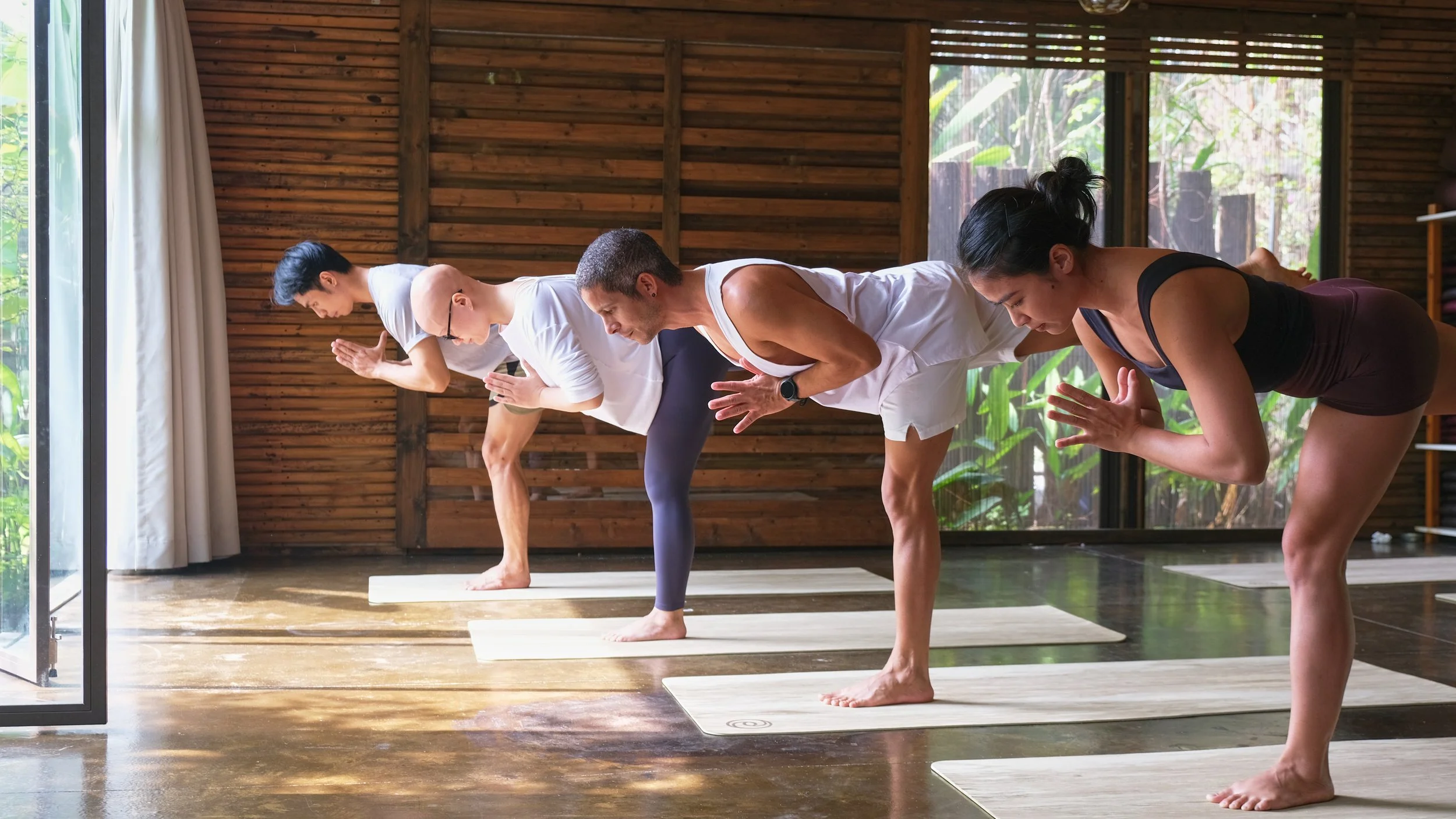
More Than a Point to Look At
Drishti comes from Sanskrit and can mean "view," "vision," or "focused gaze". In yoga, each posture is often paired with a point for the eyes to rest on: the fingertips in Warrior II, the thumb in Triangle Pose, the floor in a balance, or the navel in a fold.
At first, this may seem like a simple alignment cue. But Drishti does more than help us hold a pose.
The eyes constantly send information to the brain about where the body is in space. When the gaze keeps shifting, the nervous system has to keep recalculating. That can create more effort, more tension, and more instability. A steady gaze reduces that noise and gives the body fewer variables to manage.
In that way, Drishti is less about staring and more about simplifying. It asks the body to stop chasing every distraction and settle into one clear point of reference.
The Eyes Lead the Movement
If you watch someone prepare for a side plank, you may notice that the eyes move before the body does. The gaze finds its destination first, and only then do the hips lift, and the shape emerges. This happens outside yoga too. Before stepping off a curb, reaching for a shelf, or turning to greet someone, the eyes quietly map the action before the body follows.
Vision does not just observe movement; it helps organize it.
Yoga makes this invisible process visible. By practicing Drishti, we begin to notice how much movement is guided by attention. Instead of reacting to every sound or passing thought, the body learns to move with more intention. Transitions become smoother. Balance becomes more reliable. Even difficult poses begin to feel less like a struggle and more like a conversation with gravity.
Why One Point Can Quiet a Busy Mind
Modern life trains the mind to scatter.
Notifications flash, screens compete for attention, and even a quiet moment can be interrupted by the next thought. The brain is wired to notice novelty, which means it is always scanning for movement, sound, and change.
Drishti offers a gentle interruption to that pattern. Instead of following every stimulus, the practice asks for one simple act: stay here. Not forever, and not with force, but for this breath, and then the next one. That small return can be surprisingly powerful. It gives the mind a place to land and reminds us that focus is not about shutting the world out, but about choosing what deserves our presence.
Neuroscience supports this idea. Focused visual attention can reduce cognitive load and support concentration. Yoga understood this long before modern research could explain it: when attention becomes steadier, the mind becomes quieter.
Taking Drishti Off the Mat
The real beauty of Drishti is that it does not end when class is over.
It shows up in ordinary moments: waiting in line, walking through a crowded street, sitting in a meeting, listening to a friend without already preparing the reply. In each of those moments, attention is being asked for. Drishti reminds us that we do not have to give it away automatically.
That does not mean ignoring the world. It means choosing where presence belongs.
In daily life, Drishti becomes a way of returning - to the conversation, the task, the breath, the moment that is actually happening. The practice is subtle, but its effect can be profound. It teaches us that attention is not just something we have; it is something we can train.
Looking at What Matters
Yoga often reveals its deepest lessons through the simplest actions.
Breathing in and out. Standing still. Looking with intention.
Drishti reminds us that focus is not reserved for advanced poses or perfect balance. It is something we can practice in ordinary moments, one gaze at a time. Sometimes a yoga practice changes not when the posture changes, but when the gaze does.